


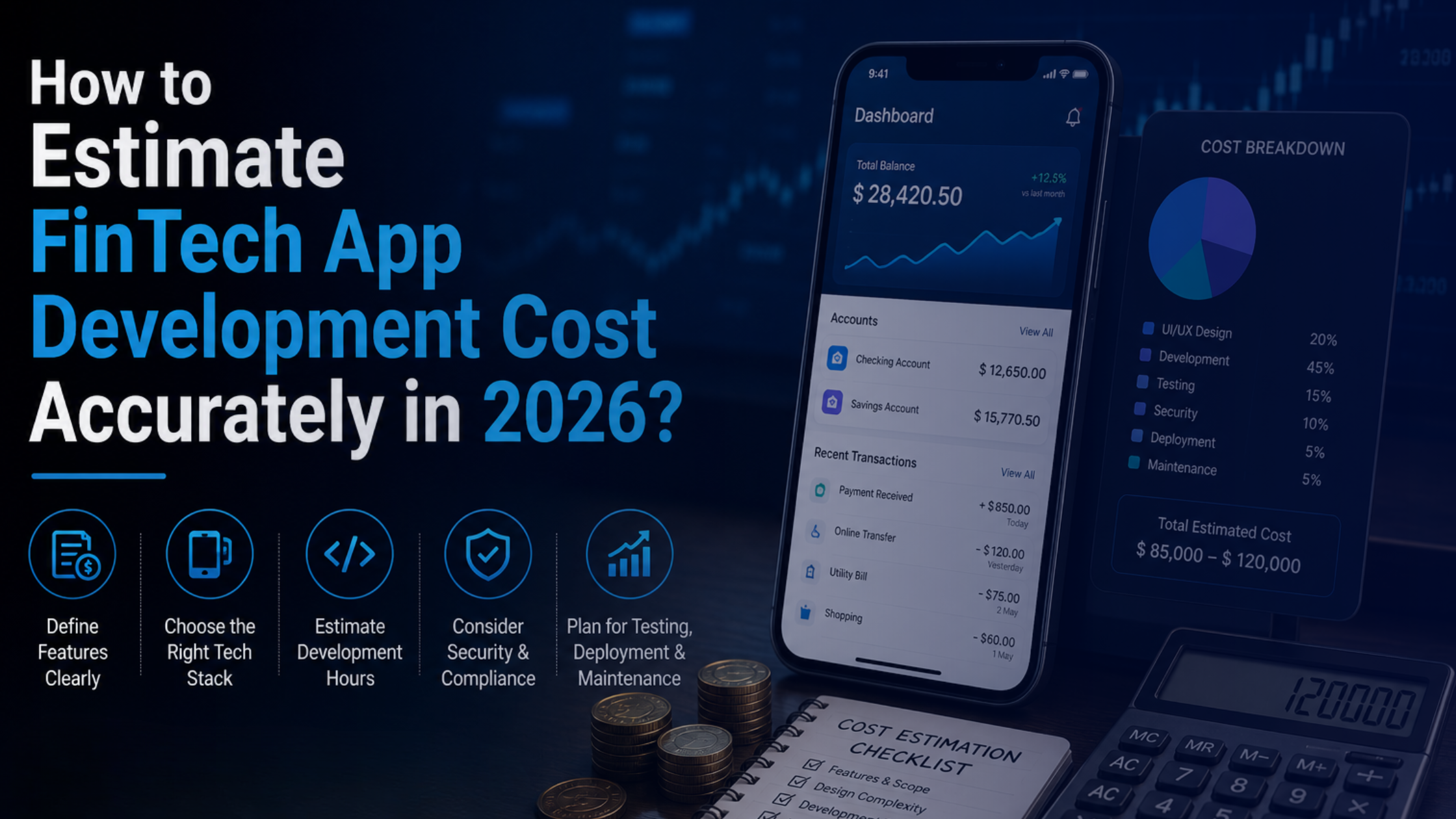
FinTech product development has transcended mere coding and now encompasses issues such as security, compliance, scalability, and customer trust. Irrespective of whether your startup focuses on a mobile wallet application, neo-banking, lending, investment, or any other FinTech service, knowledge of FinTech App Development is key before committing valuable resources.
While developing FinTech applications in 2026 comes with stiff competition in the sector, different factors, such as features, location, technology, and choice of FinTech App Development Company, play a critical role in determining pricing differences. This article explains how to accurately calculate your costs.
Why is FinTech App Development Cost Hard to Predict?
Unlike common mobile applications, FinTech applications require a more complex architecture and compliance with financial sector regulations. Such applications include, for instance, the Stripe Dashboard or the PayPal Mobile App, which store financial information and process real-time payments.
For this reason, the cost of development of a FinTech app depends on several dynamic factors, including:
- Compliance with laws (KYC, AML, GDPR)
- Information security infrastructure
- External integrations (banks, payment systems)
- Scalability needs
- Real-time data processing capabilities
Key Factors Affecting FinTech App Development Cost
For accurate budgeting, it is important to understand the key factors influencing the cost of developing a FinTech app, including app features, security considerations, regulatory compliance, technology stack, and developer expertise.
1. Type of FinTech App
Different FinTech products require vastly different levels of technical complexity, security layers, and infrastructure. This is one of the most important factors that directly affects a FinTech app, because the type of application defines everything from architecture to compliance requirements.
Digital Wallets (Moderate Cost)
Digital wallets are among the most common FinTech solutions. They typically include features like user onboarding, wallet balance management, money transfers, and transaction history.
While relatively straightforward, they still require:
- Secure payment gateway integration
- Basic fraud detection systems
- Encrypted data storage
- Multi-device synchronization
Because of their simplicity, digital wallets usually fall within a moderate range of development costs, especially when built for a single region.
P2P Payment Apps (Moderate to High Cost)
Peer-to-peer (P2P) payment apps are more advanced than wallets because they involve real-time money transfers between users.
Additional complexities include:
- Instant payment processing systems
- Bank API integrations
- Strong authentication mechanisms (OTP, biometrics)
- Fraud prevention and transaction monitoring
As transaction volume grows, scalability becomes critical, significantly increasing the overall FinTech App Development Cost.
Lending Platforms (High Cost)
Lending apps are significantly more complex due to credit scoring, risk assessment, and repayment tracking systems.
They require:
- AI-based credit scoring models
- User verification (KYC/AML compliance)
- Loan lifecycle management systems
- Automated repayment and penalty calculations
These systems often require backend-heavy development and regulatory compliance, making lending platforms a high-cost FinTech category.
Feature Complexity
Features greatly influence the cost of Fintech App Development, as each requires effort to develop. Basic features such as user login and account history are easy to implement, but sophisticated features make everything complex.
As the scope of features grows, more resources are spent on testing and infrastructure, increasing development costs.
Design and User Experience
The design and user experience greatly affect costs, as they determine how users will interact with the products. An interface is cheaper to develop than one that requires animations and personalization to achieve the desired user experience. Costly UX driven by research yields trust, better usability, and increased user retention.
Technology Stack
The choice of a technology stack is essential to consider when calculating development costs, as it directly affects performance, scalability, and security. Technologies such as React Native, Flutter, Node.js, Python, and Java significantly increase development costs. Cloud-based services like AWS and Azure offer increased scalability but require additional time to set up.
Security and Compliance
Security, along with regulatory compliance, is one of the main cost components in the creation of FinTech solutions, as it helps protect financial information and ensure compliance. Advanced encryption, multi-factor authentication, tokenization, and fraud-prevention systems all require specialized engineering. Compliance with financial regulations and audits makes FinTech even more expensive.
Development Team Location
The physical location of the development team can significantly influence the cost of FinTech app development, as hourly rates vary by region. USA and UK firms charge the highest rates, while Eastern European firms charge average rates. The South Asian region, comprising countries such as India and Pakistan, offers lower startup costs.
How to Estimate FinTech App Development Cost?
In determining the cost of FinTech development, there is a need for a systematic process that allows splitting the task into manageable units. This will help ensure that costs do not exceed the estimates.
Step 1: Define MVP Scope
- Identify core features such as user registration, a wallet system, basic transactions, and an admin dashboard.
- Reduces initial development cost by 40–60%
Step 2: Break Down Features into Modules
- User, payment, admin, and security modules defined.
- Estimate effort and complexity separately for each module.
Step 3: Estimate Development Hours
- UI/UX design: 200–400 hours
- Backend development: 500–1000 hours
- Mobile app development: 600–1200 hours
- Testing & QA: 200–400 hours
- Multiply hours by developer rate
Step 4: Add Compliance and Security Costs
- Allocate 15–30% extra budget
- Covers legal compliance, security audits, and integrations.
Step 5: Include Maintenance Costs
- Annual maintenance: 15–20% of total cost
- Includes updates, bug fixes, and server management.
Choosing the Right FinTech App Development Company
Choosing the right FinTech App Development Company is crucial to creating a highly secure, scalable financial solution. It should be noted that a good mobile app development company will always have experience with financial products, stable security policies, and knowledge of regulatory issues. It should also provide clients with scalable architecture design and reliable maintenance services after the project launch. To select the right provider, one needs to check the cases in payment systems, lending applications, or digital banks.
Final Thoughts
FinTech app cost estimation should be based on variables that may affect the final estimate. These variables include the type of application being developed, its features and security measures, the technology used, and the development team’s location. By conducting a thorough cost estimation exercise and working with an expert FinTech app development company, one can develop a safe and successful solution.
