


What Does “ATAR” Actually Mean?
ATAR stands for Australian Tertiary Admission Rank. It is not a percentage or a raw exam score; it is a percentile rank that shows how you compare to other students in your age group who started school in the same cohort.
An ATAR is written as a number between 0.00 and 99.95, in steps of 0.05. If your ATAR is 80.00, that means you performed as well as or better than 80% of Australian students in your age group.
Likewise, an ATAR of 99.95 means you sit at the very top of the national cohort, outperforming almost everyone your age.
How ATAR Is Used in Australia
ATAR is the main ranking system that Australian universities use to decide who gets into undergraduate courses.
Each course lists a minimum ATAR cut‑off (for example, “ATAR 85”) that tells you the typical rank required for an offer.
Some key points:
- ATAR is used for local school‑leavers (e.g., HSC, VCE, QCE, WACE, SACE, TCE, BSSS students).
- Universities sometimes apply adjustment factors (bonus points) for rural students, hardship, or elite sport, which can improve your effective ATAR.
- Even if your score is a little below a course’s cut‑off, you may still receive an offer if you meet other criteria or if demand varies that year.
How ATAR Is Calculated (General Process)
Although the exact rules vary by state, the overall process is similar across Australia.
Step 1: Subject Results
Each state’s Year 12 system gives you results for each subject (HSC marks, VCE study scores, QCE Units 3 and 4, etc.). These results usually come from a mix of internal school assessments and external exams.
Step 2: Scaling
Your raw subject scores are then scaled to account for differences in difficulty and how well each subject’s cohort performs.
This means that two students with the same raw mark in different subjects can end up with different scaled scores, depending on how hard or easy the subject is and how strong the group of students is.
Step 3: Aggregate and Rank
A state admissions centre (such as UAC in NSW, VTAC in VIC, QTAC in QLD, TISC in WA, SATAC in SA, etc.) combines your best scaled subject scores into a scaled aggregate.
All eligible students are then ranked by this aggregate, and those ranks are converted into percentile ATAR bands (0.00–99.95).
ATAR in Different States (2026 Snapshot)
Each Australian state uses a slightly different formula, but all feed into the same ATAR number.
- NSW (HSC): Uses your best 2 units of English plus 8 other eligible units to form an aggregate, which is converted into an ATAR by UAC.
- VIC (VCE): VTAC typically uses your English score plus your next 3 best study scores, then adds 10% of two more subjects to form an aggregate.
- QLD (QCE): QTAC builds an ATAR from your best five scaled QCE subjects, with specific rules for combinations of General, Applied, and VET courses.
- WA (WACE), SA (SACE), TAS (TCE), ACT (BSSS): Each has its own way of selecting and scaling subjects, but all end up with a 0.00–99.95 ATAR that is comparable nationally.
This means that whether you study in Sydney, Melbourne, Brisbane, Perth, Adelaide, Hobart, or Canberra, your ATAR can be compared directly when applying to universities anywhere in Australia.
Why ATAR Is Important for Australian Students
For Australian high‑school leavers, ATAR is the main gateway into most undergraduate programs.
Here’s why it matters:
- Course eligibility: Many degrees set a minimum ATAR (for example, medicine might require ATAR 97+, while Arts might accept ATAR 65–70).
- Planning years in advance: Knowing how ATAR is calculated helps you choose subjects and aim for target scores in Years 11 and 12.
- Realistic pathway decisions: If your projected ATAR is below a course’s cut‑off, you can decide whether to retake exams, consider related courses, or enter via alternative pathways (foundation years, diplomas, etc.).
Some states also publish ATAR‑band data, such as the fact that the average ATAR often sits around 70.00, though this can vary slightly by state.
ATAR and International Students
International students encounter ATAR in two main ways.
International Students Studying in Australia
If you are an international student completing HSC, VCE, QCE, or another Australian Year 12 system, you will receive a regular ATAR just like local students.
You can then use that ATAR to apply through admissions centres (such as VTAC or UAC) for most undergraduate courses.
International Students from Overseas
If you studied abroad (e.g., IB, A‑Levels, national exams from China, India, or Southeast Asia), you do not receive an ATAR, but Australian universities often convert your score into an ATAR equivalent.
Each university has its own conversion table, so your IB score or A‑Level results might be treated as “equivalent to ATAR 80–90” at one university but slightly different at another.
This helps admissions teams compare your performance against Australian students using the same scale.
Common Myths About ATAR
Because ATAR is so important, it is also often misunderstood. Here are some frequent myths clarified.
- Myth: ATAR is a percentage mark.
Truth: ATAR is a rank, not a score out of 100. It shows how you compare to others, not what you scored on a particular exam. - Myth: Every subject you take counts toward your ATAR.
Truth: Only your best eligible subjects (usually 5 or 10 units, depending on the state) are used to form the scaled aggregate. - Myth: International students must have an ATAR.
Truth: Only students who complete an Australian Year 12 system receive an ATAR; others are assessed via ATAR‑equivalent conversions.
Correcting these myths helps students focus on smart subject choices and realistic targets, rather than chasing abstract “perfect” scores.
How to Use Tools Like an “ATAR Calculator”
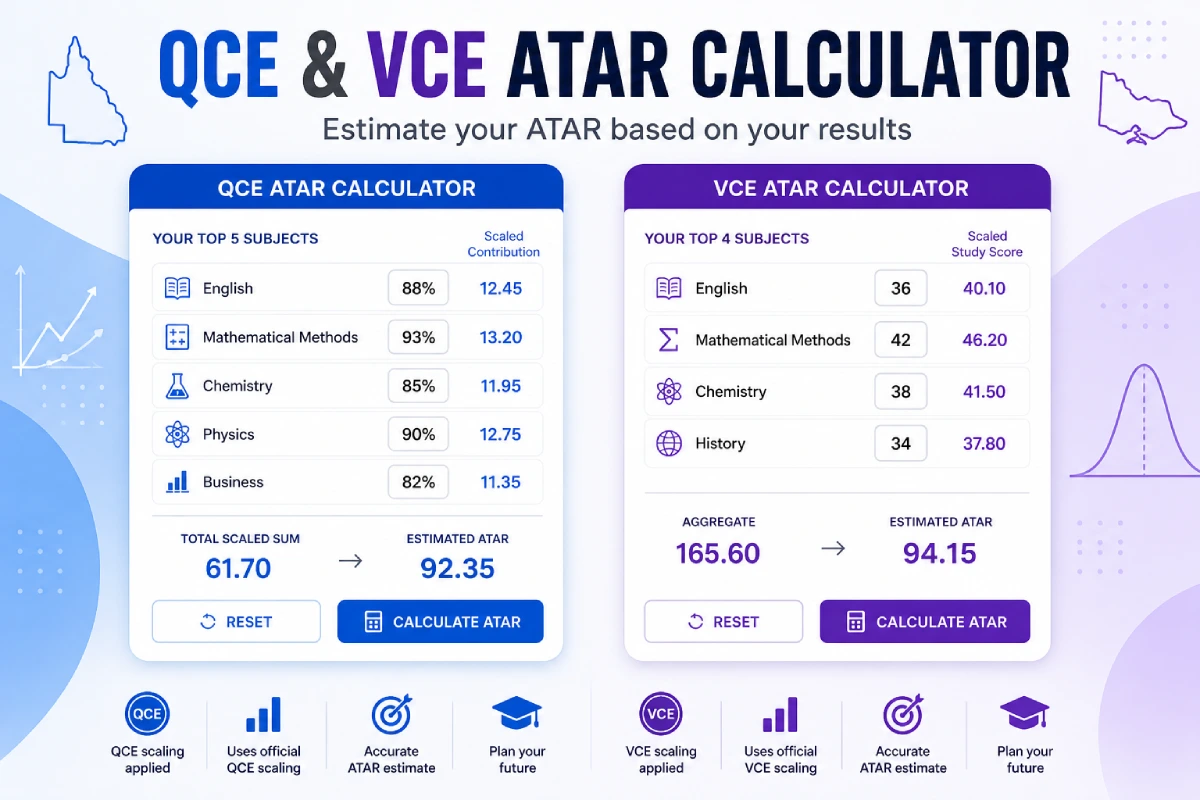
To plan in 2026, many students use ATAR Calculator to estimate their final rank before official results arrive.
These tools let you:
- Enter your predicted subject scores for HSC, VCE, QCE, or other systems.
- See how scaling affects your aggregate and projected ATAR.
- Test “what‑if” scenarios (for example, “What if I improve by 10 points in Maths?”).
While ATAR Calculators are not official, they are useful for setting realistic goals and understanding which subjects will help or hinder your ATAR.
Final Thoughts: Why ATAR Still Matters in 2026
ATAR remains the standard ranking system for Australian university entry in 2026, used by domestic students, international students in Australian schools, and even medical and competitive‑course selectors who convert overseas scores into ATAR equivalents.
Understanding what ATAR is, how it is calculated, and how it is used helps you:
- Choose the right subjects.
- Aim for realistic ATAR targets.
- Decide whether to apply directly, use adjustment factors, or enter via alternative pathways.
